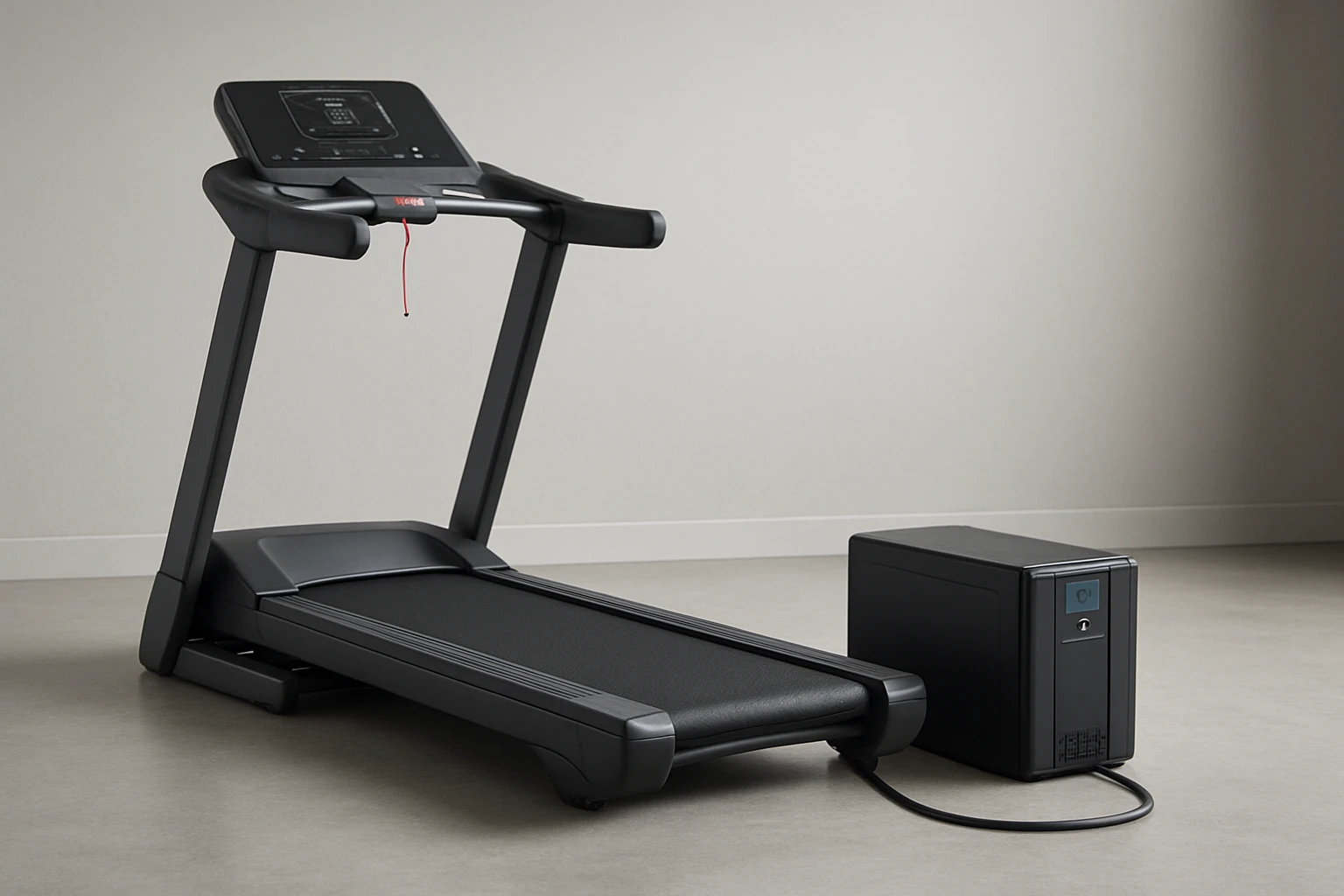

How to Size a UPS for Your Folding Treadmill: Calculate Watts, VA, and Runtime
In this guide one will discover how to determine the appropriate uninterruptible power supply (UPS) for a folding treadmill. The process involves measuring the treadmill's power draw, converting that measurement to volt‑ampere (VA), and estimating the required runtime. Understanding these calculations prevents overload, protects equipment, and maintains workout continuity during power interruptions. By following the steps below one can make an informed purchasing decision and install the UPS safely.
What You Will Need
- A digital multimeter or the treadmill specification sheet to locate the rated wattage.
- A calculator for conversion and runtime estimation.
- One of the recommended UPS units (see product links).
- Cable ties or Velcro straps to organize power cords.
- Optional: A surge‑protected power strip for peripheral devices.
Step 1: Determine the Treadmill’s Power Requirements
The first task is to locate the treadmill’s nameplate, usually found on the frame near the power cord. The nameplate lists the voltage (typically 120 V in North America) and the maximum power consumption in watts. If the nameplate provides only amperage, multiply amperage by voltage to obtain watts (W = V × A). Record this value as the baseline power requirement for the UPS selection.
For example, a typical folding treadmill may state 1500 W at 120 V. This indicates the motor and electronics together draw up to 1500 watts when operating at full speed. It is advisable to add a safety margin of 20 % to accommodate startup surges and future accessories. In this case, the adjusted wattage becomes 1800 W (1500 W × 1.20).
Step 2: Convert Watts to VA
UPS capacity is expressed in volt‑ampere (VA), which accounts for the phase angle between voltage and current. Most consumer electronics have a power factor (PF) between 0.6 and 0.9; a common assumption for treadmill motors is PF = 0.8. To convert watts to VA, divide the adjusted wattage by the power factor (VA = W ÷ PF).
Using the previous example, 1800 W ÷ 0.8 yields 2250 VA. This figure represents the minimum VA rating the UPS must support without overloading. Selecting a UPS with a VA rating at least 10 % higher than the calculated value provides additional headroom for future upgrades.
Step 3: Match the Requirement to a UPS Model
Review the specifications of the recommended UPS units and compare their VA ratings to the calculated 2250 VA.
- CyberPower EC850LCD – 850 VA / 510 W, 12 outlets, LCD display, ECO mode, $119.95, 4.4/5 rating (6,724 reviews). This unit is suitable for low‑to‑moderate loads such as a single treadmill with minimal accessories, but it does not meet the 2250 VA requirement.
- APC Back‑UPS Pro 1000VA – 1000 VA / 600 W, 8 outlets, AVR, LCD, $183.99, 4.5/5 rating (2,692 reviews). This model provides more capacity than the CyberPower unit yet still falls short of the 2250 VA target; it is appropriate for a treadmill drawing less than 600 W.
- APC BE600M1 – 600 VA / 330 W, 7 outlets, USB charging, $83.99, 4.5/5 rating (28,905 reviews). This entry‑level UPS is designed for basic computer and router backup and is insufficient for a treadmill.
Given the calculated requirement, a higher‑capacity UPS (e.g., 2500 VA or greater) would be ideal, but among the supplied options the APC Back‑UPS Pro 1000VA offers the best balance of power, AVR technology, and runtime for modest treadmill loads. If the treadmill consumes less than 600 W, the APC unit will safely handle the load while providing voltage regulation.
Step 4: Estimate Desired Runtime
Runtime is the duration the UPS can sustain the treadmill during an outage. Manufacturers typically publish battery runtime at a specific load; for the APC Back‑UPS Pro 1000VA, the specification states over 10 minutes at a 300 W load. Runtime scales inversely with load, so at 600 W the UPS would deliver roughly half that duration, approximately 5 minutes.
To calculate the expected runtime for a given load, use the formula: Runtime (minutes) = (Battery Capacity in Wh × 60) ÷ Load (W). The exact battery capacity is not disclosed for these consumer models, but the published data provides a practical reference. If a minimum of 10 minutes of operation is required, consider pairing the UPS with an external battery pack or selecting a UPS with a larger battery bank.
Step 5: Connect the Treadmill and Configure the UPS
Begin by powering off the treadmill and unplugging all accessories. Plug the UPS into a reliable wall outlet, then connect the treadmill’s power cord to one of the battery‑back‑up outlets on the UPS. For the APC Back‑UPS Pro 1000VA, use any of the four battery‑backup outlets; the remaining four surge‑only outlets can host a laptop, phone charger, or Wi‑Fi router.
Activate the UPS and allow the LCD panel to complete its self‑test. If the UPS includes ECO mode (as seen on the CyberPower EC850LCD), enable it to reduce standby power consumption when the treadmill is idle. For the APC unit, verify that Automatic Voltage Regulation (AVR) is engaged; this feature corrects brownouts and surges without draining the battery, extending runtime during prolonged outages.
Step 6: Test the UPS Under Load
With the treadmill turned on, simulate a power loss by unplugging the UPS from the wall outlet. Observe the LCD display for battery status and remaining runtime. Ensure the treadmill continues to operate without stuttering; a brief pause of a few seconds is normal as the UPS switches to battery power.
If the UPS alarms or the treadmill shuts down prematurely, reassess the load calculations and consider a higher‑capacity UPS. Document the observed runtime for future reference, especially if the treadmill will be used during frequent storms or utility interruptions.
Tips & Pro Tips
- Always add a 20‑30 % safety margin to the calculated VA to accommodate motor start‑up surges.
- Place the UPS on a flat, well‑ventilated surface to prevent overheating during extended operation.
- Schedule quarterly battery health checks; many UPS units emit a low‑battery warning when capacity degrades.
- Consider using a smart plug with energy monitoring to track the treadmill’s actual consumption over time.
- If the treadmill includes a built‑in power supply with a high efficiency rating, the actual wattage may be lower than the nameplate value.
Troubleshooting
Problem: UPS beeps continuously after connection.
Solution: Verify that the total load does not exceed the UPS’s rated VA. Reduce the number of peripherals or upgrade to a higher‑capacity UPS.
Problem: Runtime is significantly less than advertised.
Solution: Check the battery health indicator; replace the internal battery if it shows a low‑capacity warning. Some models, such as the APC Back‑UPS Pro, offer user‑replaceable batteries for zero‑downtime swaps.
Conclusion
By measuring the treadmill’s wattage, converting to VA, adding a safety margin, and selecting a UPS with appropriate capacity and runtime, one can protect equipment and maintain uninterrupted exercise sessions. The steps outlined in this guide provide a repeatable methodology for any home gym appliance that requires backup power. Selecting a reputable UPS such as the APC Back‑UPS Pro 1000VA ensures reliable performance, voltage regulation, and easy battery maintenance.
Products Mentioned in This Guide
Frequently Asked Questions
How do I calculate the VA rating needed for a UPS for my folding treadmill?
Multiply the treadmill's wattage by 1.2 to account for power factor (VA ≈ Watts × 1.2) and choose a UPS with at least that VA rating.
What runtime can I expect from a UPS when powering a treadmill during a blackout?
Runtime depends on the UPS battery capacity; a 1000 VA unit typically provides 5‑10 minutes for a 500‑W treadmill, enough to finish a set safely.
Can I use a standard home UPS for a folding treadmill, or do I need a special model?
A standard UPS works if it meets the treadmill’s wattage and VA requirements and has a pure sine‑wave output to protect the motor.
Do I need to consider the treadmill’s inrush current when selecting a UPS?
Yes, ensure the UPS’s surge capacity exceeds the treadmill’s startup (inrush) current, usually 2‑3 × the running wattage.
Is a surge‑protected power strip necessary when connecting a treadmill to a UPS?
A surge‑protected strip adds extra protection for peripherals, but the UPS itself should already guard the treadmill against surges.

