
How to Run a Folding Treadmill on Solar Power: The Complete DIY Guide
Introduction
The modern home office often includes a compact treadmill that enables movement while working. This guide explains how to power such a folding treadmill using renewable solar energy. Readers will learn how to calculate power demand, select appropriate solar components, and safely wire the system. By the end of the article, one will possess a clear, actionable plan for a self‑sufficient treadmill setup.
Background and Context
Solar power conversion relies on photovoltaic panels that generate direct current (DC) electricity from sunlight. That DC must be transformed into alternating current (AC) for most household appliances, including treadmills. Understanding voltage, wattage, and battery storage is essential before any hardware is purchased. The following sections provide the technical foundation required for a reliable DIY installation.
Assessing Power Requirements
First, determine the treadmill's energy consumption. The NordicTrack T Series lists a motor capable of 2.5 horsepower, which translates to roughly 1,860 watts at peak load. The WELLFIT Folding Treadmill uses a 3.0 HP motor rated at about 2,200 watts. For continuous operation, a safety margin of 25 percent should be added, resulting in an estimated 2,300‑2,800 watt demand.
Next, calculate daily energy usage. If the treadmill runs for one hour per day at average power of 2,000 watts, the energy consumption equals 2 kilowatt‑hours (kWh). Multiply by the number of days between battery recharges to size the storage correctly.
Finally, consider inverter efficiency. A high‑quality sine‑wave inverter typically operates at 90‑95 percent efficiency, meaning the solar array must produce slightly more power than the treadmill consumes.
Selecting a Solar Panel Kit
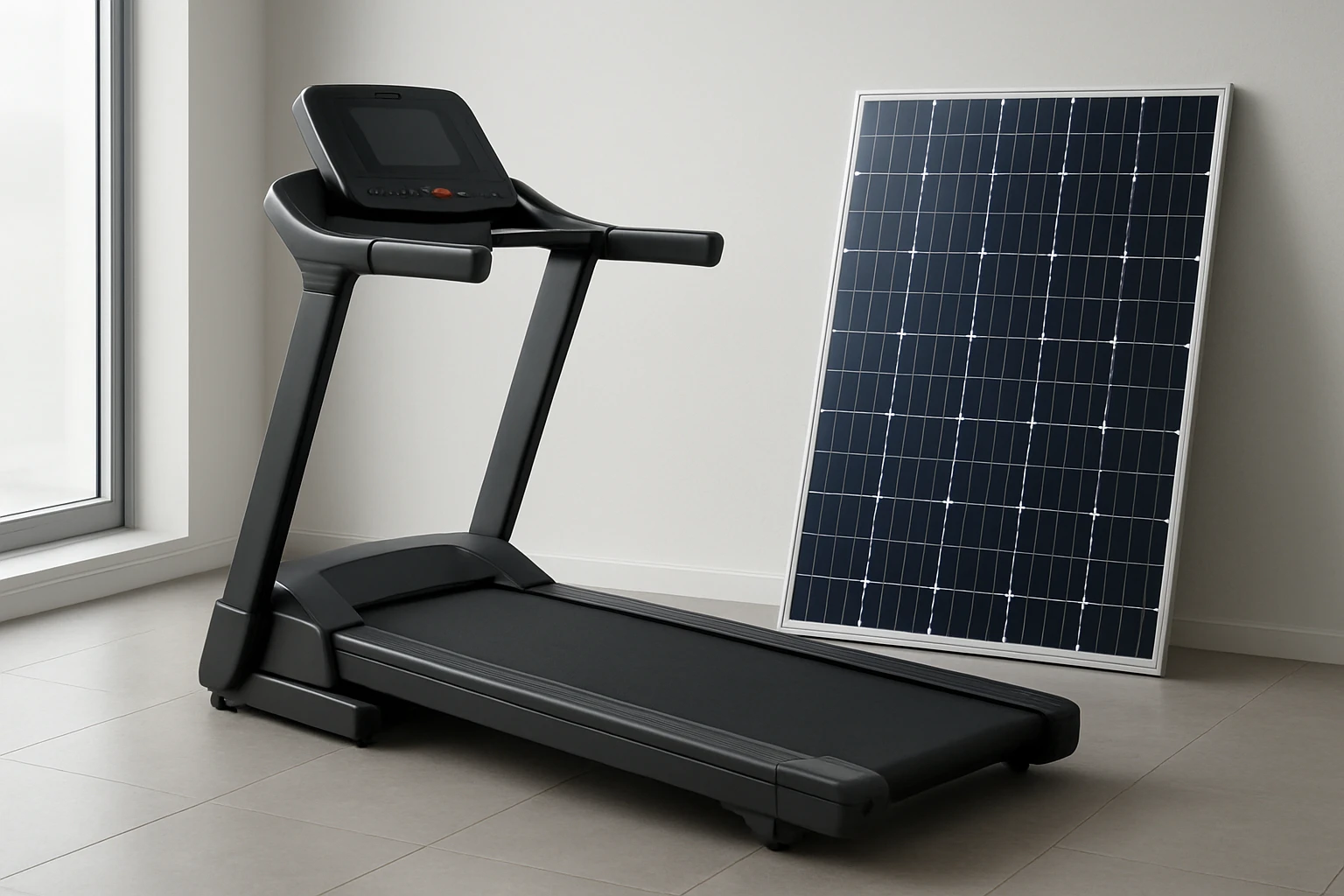
The ECO‑WORTHY Solar Panel Kit provides four 100‑watt monocrystalline panels, delivering a combined peak output of 400 watts. Each panel features 25 percent efficiency and low‑light performance, which is valuable in regions with variable sunlight. The kit includes pre‑wired connectors and an IP68‑rated junction box, simplifying installation for beginners.
Given the treadmill’s 2,000‑watt demand, the 400‑watt kit alone cannot sustain continuous operation without supplemental grid power or a larger array. However, the kit serves as an excellent proof‑of‑concept and can be expanded with additional panels of the same specifications.
When selecting additional panels, match voltage and current ratings to the existing inverter and charge controller. Maintaining identical panel models ensures balanced string performance and simplifies troubleshooting.
Choosing a Folding Treadmill
The two treadmills featured differ in footprint, motor power, and cushioning technology. The NordicTrack T Series offers a 5‑inch LCD display, iFIT integration, and selectable cushioning (SelectFlex™ and KeyFlex™). It supports speeds up to 12 mph and inclines up to 12 percent, appealing to runners who require higher intensity workouts. Its price of $799 and rating of 4.3 stars from 33,426 reviews indicate strong market acceptance.
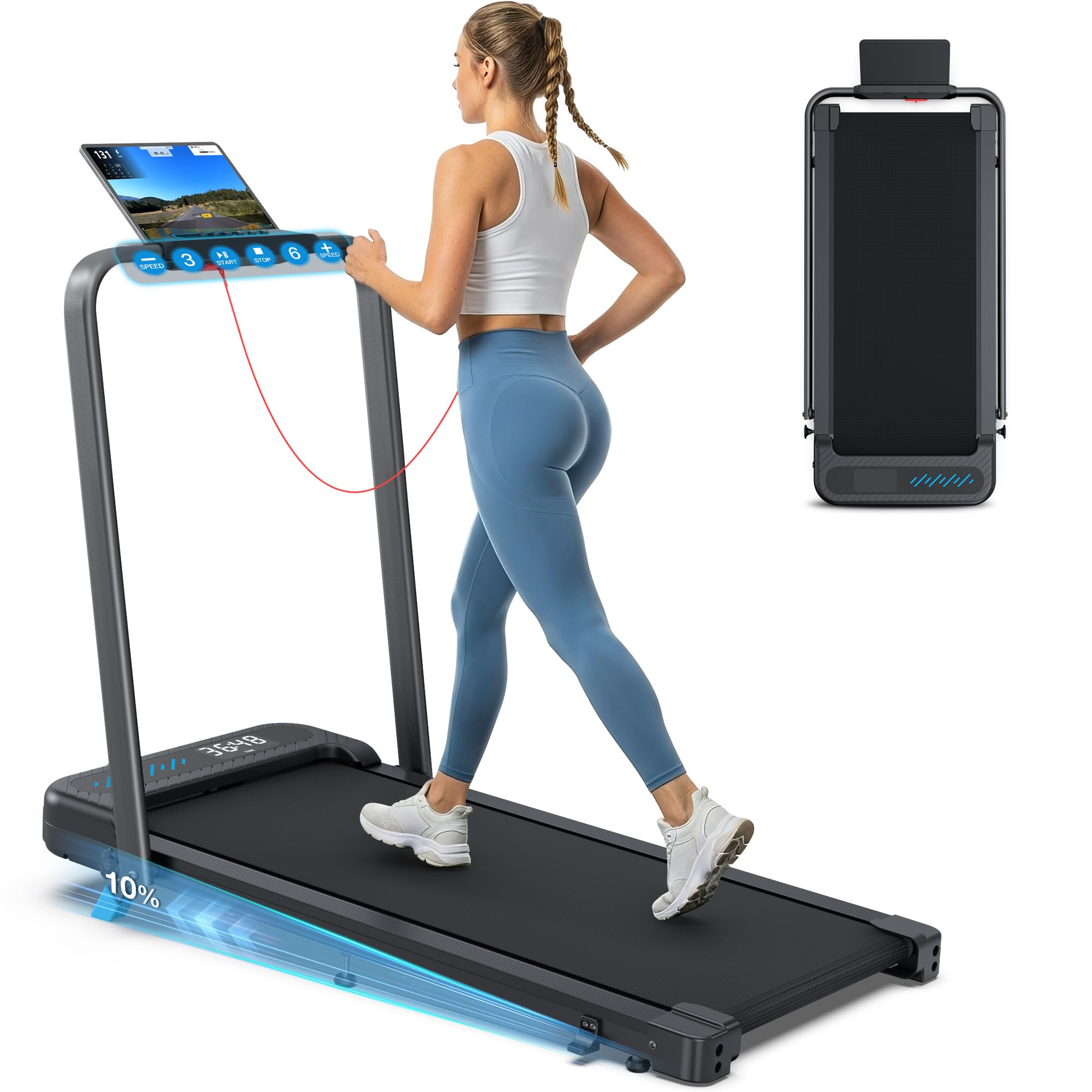
The WELLFIT Folding Treadmill emphasizes portability, with a compact folded thickness of 5 inches and a quiet 3.0 HP motor limited to 6.2 mph. Its 5‑layer cushion belt reduces joint impact, making it suitable for office use and low‑impact cardio. Priced competitively and rated 4.5 stars from 272 reviews, it offers excellent value for space‑constrained environments.
For a solar‑powered setup, the WELLFIT model may be preferable because its lower maximum power draw reduces the size of the required solar array and battery bank. Nevertheless, the final decision should align with the user’s fitness goals and available space.
Designing the Electrical System
A typical off‑grid treadmill system comprises solar panels, a charge controller, a deep‑cycle battery bank, an inverter, and the treadmill itself. The charge controller regulates voltage and prevents over‑charging; a maximum‑power‑point‑tracking (MPPT) controller is recommended for the high‑efficiency ECO‑WORTHY panels.
The battery bank must store at least the daily energy consumption plus a 20 percent reserve. For a 2 kWh daily load, a 2.5 kWh lithium‑iron‑phosphate (LiFePO4) bank would provide sufficient depth‑of‑discharge while maintaining long cycle life.
The inverter should be rated at least 2,500 watts continuous, with a pure sine‑wave output to protect the treadmill’s motor electronics. Ensure all wiring complies with local electrical codes, using appropriately sized copper conductors (e.g., 10 AWG for 400‑watt panel strings).
Installation and Wiring
Begin by mounting the solar panels on a roof or ground‑mounted rack oriented toward true south (in the Northern Hemisphere) at a 30‑degree tilt. Secure the panels using the supplied brackets and verify that the wiring is protected from weather exposure.
Connect the panel strings to the MPPT charge controller, then link the controller to the battery bank using thick, insulated cables. Install a fuse or circuit breaker between the controller and batteries to safeguard against over‑current conditions.
Attach the inverter to the battery bank, observing correct polarity. Finally, plug the treadmill into the inverter’s AC outlet, and perform a gradual power‑up sequence: battery → inverter → treadmill. Monitor voltage and current readings during the first run to confirm that the system operates within design limits.
Testing and Optimization
After installation, conduct a load test by operating the treadmill for a typical workout duration. Record the inverter’s output power, battery state‑of‑charge, and panel generation throughout the session. Adjust panel tilt or add additional panels if the battery depth‑of‑discharge exceeds 50 percent.
Implement a monitoring solution, such as a solar app compatible with the charge controller, to track performance over time. Regularly clean panel surfaces to maintain efficiency, especially in dusty environments.
Optimizing the treadmill’s speed and incline settings can also reduce power draw. For example, using a 5‑mph walk with a 2‑percent incline consumes significantly less energy than a 10‑mph run at 10‑percent incline.
Comparison and Selection Guide
| Feature | NordicTrack T Series | WELLFIT Folding Treadmill |
|---|---|---|
| Maximum Speed | 12 mph | 6.2 mph |
| Incline Range | 0‑12 % | 0‑10 % |
| Cushioning | SelectFlex™ / KeyFlex™ | 5‑Layer Cushion Belt |
| Footprint (Folded) | Compact, but not ultra‑thin | 5 inches thick |
| Price | $799.00 | Not disclosed, competitive |
| Rating | 4.3/5 (33,426 reviews) | 4.5/5 (272 reviews) |
For users prioritizing high‑intensity training, the NordicTrack model offers greater speed and incline capabilities. For those focused on space efficiency and lower power consumption, the WELLFIT treadmill is the more suitable choice.
Best Practices & Tips
- Size the battery bank for at least two days of autonomy to accommodate cloudy weather.
- Use MPPT charge controllers to maximize energy harvest from high‑efficiency panels.
- Regularly inspect cable connections for corrosion or looseness.
- Consider adding a solar tracker if the installation site receives abundant direct sunlight.
- Maintain the treadmill’s belt tension and lubrication to reduce motor load.
Frequently Asked Questions
- Can I run a treadmill directly from solar panels without a battery?
- Direct operation is possible only when the panels generate sufficient power at every moment, which is unlikely during variable sunlight. A battery buffer ensures continuous operation.
- How many panels are required for a 2 kWh daily load?
- Assuming 5 peak sun hours, a 400‑watt array yields 2 kWh. Therefore, four 100‑watt panels, as in the ECO‑WORTHY kit, meet the minimum requirement, but a larger margin is advisable.
- Will the inverter affect treadmill performance?
- A pure sine‑wave inverter preserves the treadmill’s motor waveform, preventing overheating and ensuring smooth acceleration.
- Is lithium‑ion battery mandatory?
- While lead‑acid batteries can be used, lithium‑ion or LiFePO4 batteries provide higher depth‑of‑discharge, longer life cycles, and lighter weight, which are advantageous for portable setups.
- What safety devices are required?
- Install a DC disconnect between panels and controller, a fuse on the battery‑to‑inverter line, and a ground‑fault circuit interrupter (GFCI) on the AC side to protect users.
Conclusion
Powering a folding treadmill with solar energy is a feasible and environmentally responsible project. By accurately estimating power demand, selecting a compatible solar panel kit, and constructing a robust electrical system, one can achieve reliable, off‑grid cardio training. The guide has presented the necessary calculations, product recommendations, and safety considerations to empower readers to undertake the installation confidently.
Products Featured in This Guide
NordicTrack T Series
Price: $799.00
Rating: 4.3/5 (33,426 reviews)
Featured because it represents a high‑performance treadmill that illustrates power‑draw calculations for solar sizing.
WELLFIT Folding Treadmill
Price: Not disclosed
Rating: 4.5/5 (272 reviews)
Featured for its compact design and lower power consumption, making it ideal for small‑scale solar installations.
ECO‑WORTHY Solar Panel Kit
Price: $196.00
Rating: 4.6/5 (539 reviews)
Featured because its high‑efficiency monocrystalline panels provide a solid foundation for a DIY solar‑powered treadmill system.