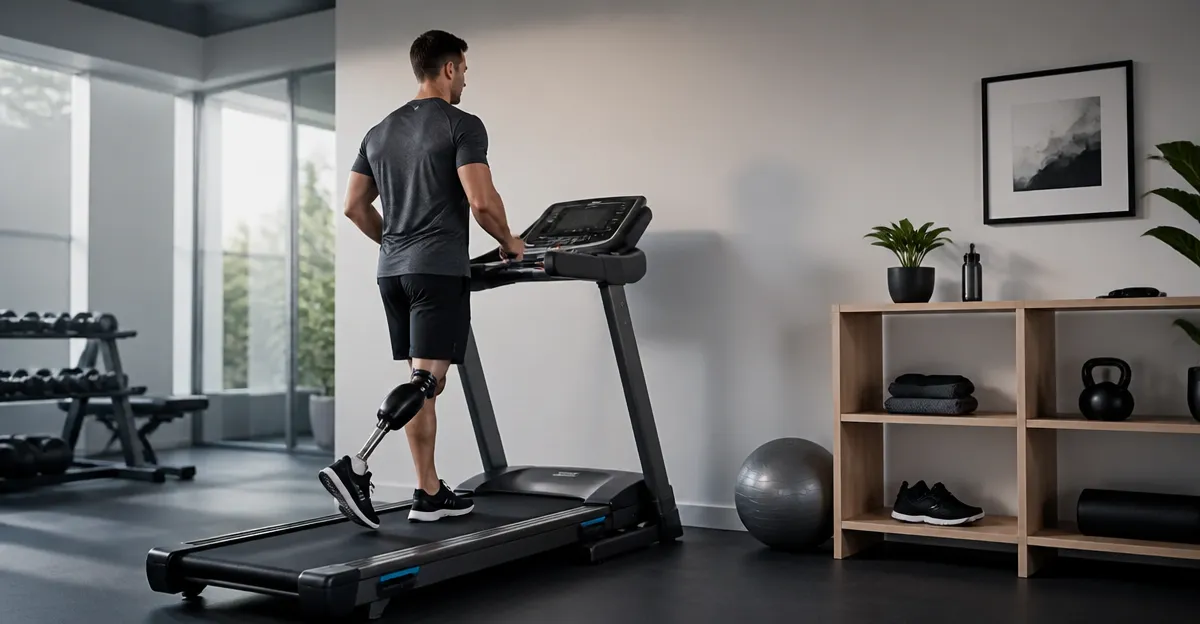
How to Adapt a Folding Treadmill for Prosthetic Users: Safety, Modifications & Setup Guide
Introduction
Folding treadmills have become essential tools for home fitness, especially for individuals with limited space. For prosthetic users, these devices can provide a controlled environment to rebuild strength, improve balance, and maintain cardiovascular health. This guide explains the safety considerations, necessary modifications, and step‑by‑step setup procedures that enable prosthetic users to exercise confidently on a folding treadmill.
Readers will learn the biomechanical principles that affect prosthetic gait, discover how to select a treadmill that accommodates specific needs, and receive actionable tips for customizing the equipment. Real‑world product examples are included to illustrate how features such as motor noise, belt width, and incline options influence usability.
By the end of this article, one will be able to evaluate treadmill options, implement safety accessories, and create a routine that supports rehabilitation goals while protecting the prosthetic limb.
Background / Context
Prosthetic gait differs from natural gait because the user must compensate for altered limb dynamics, weight distribution, and socket fit. The treadmill surface must therefore be stable, shock‑absorbing, and wide enough to prevent edge‑related anxiety. In addition, motor noise should be low to avoid distraction, and speed increments should be fine‑grained for gradual progression.
Research indicates that regular treadmill walking can improve residual limb proprioception and reduce the risk of overuse injuries in the sound limb. However, inappropriate equipment can exacerbate socket pressure, cause slippage, or lead to falls. Understanding these risks is the first step toward a safe adaptation.
Key concepts include:
- Load capacity: The treadmill must support the combined weight of the user and prosthetic components.
- Belt dimensions: A belt at least 90 cm wide provides a comfortable margin for balance.
- Motor power and noise: Motors above 400 W typically deliver smooth acceleration without excessive sound.
- Incline functionality: Adjustable incline can simulate uphill walking, which strengthens the residual limb and core.
Choosing the Right Folding Treadmill
When evaluating folding treadmills for prosthetic users, prioritize the following criteria:
- Maximum load capacity of at least 120 kg (264 lb) to accommodate most users.
- Quiet motor operation (under 50 dB) to maintain focus during therapy.
- Wide, non‑slip belt with multiple shock‑absorption layers.
- Adjustable handrails or removable handlebars for customized support.
- Ease of folding and mobility for storage in therapy rooms or home apartments.
The following products meet many of these requirements and are highlighted for their specific strengths.
Product Highlights
The first product examined is the Ulfario Folding Walking Pad. It offers a 440 W motor, a 90 × 38 cm belt, and a maximum load of 120 kg. Its compact footprint (104 × 48.7 × 10.5 cm when folded) makes it suitable for apartments, while the built‑in remote allows hands‑free speed adjustments.
Next, the Trailviber Auto Incline Walking Pad introduces a 12 % auto‑incline range and a robust 450 lb capacity. The integrated Bluetooth speaker and FitYo app add motivational elements, and the 2.5 HP motor remains quiet despite the higher power output.
The FOUSAE 5‑in‑1 Foldable Treadmill combines speed versatility (0.6–7.5 MPH) with a 3.0 HP brushless motor and a 400 lb load limit. Its 12 HIIT programs and app connectivity provide structured workouts for users seeking progressive challenges.
Finally, the Wellfit Auto Incline Folding Treadmill delivers a 3.5 HP motor, 0–10 % auto‑incline, and adjustable handrails ranging from 30.5 to 41 inches, which is particularly valuable for prosthetic users of varying heights.
Comparison / Selection Guide
| Feature | Ulfario Folding Walking Pad | Trailviber Auto Incline Walking Pad | FOUSAE 5‑in‑1 Foldable Treadmill | Wellfit Auto Incline Folding Treadmill |
|---|---|---|---|---|
| Price (USD) | $89.98 | $289.00 | $199.99 | $379.99 |
| Maximum Load | 120 kg (264 lb) | 204 kg (450 lb) | 181 kg (400 lb) | 181 kg (400 lb) |
| Motor Power | 440 W | 2.5 HP | 3.0 HP Brushless | 3.5 HP |
| Belt Size | 90 × 38 cm | Not specified (large) | 40 × 16 in (≈101 × 41 cm) | 44 × 17 in (≈112 × 43 cm) |
| Incline | None (flat) | 0–12 % Auto | 10 % Fixed | 0–10 % Auto |
| Noise Level | Quiet (under 50 dB) | Quiet (under 50 dB) | Quiet (brushless) | Under 45 dB |
| Remote Control | Yes | Yes | Yes | Yes |
| App Integration | Basic LED display | FitYo app + Bluetooth speaker | Fitness app compatibility | Standard fitness apps |
| Customer Rating | 4.3/5 (2,353 reviews) | 4.7/5 (2,072 reviews) | 4.6/5 (763 reviews) | 4.6/5 (121 reviews) |
For prosthetic users who require a sturdy platform with a high weight capacity, the Trailviber and Wellfit models stand out. Users who prioritize portability and budget may find the Ulfario model sufficient, provided the incline is not essential. The FOUSAE treadmill offers a balanced mix of speed range and integrated HIIT programs, making it ideal for progressive conditioning.
Best Practices & Tips for Safe Adaptation
The following checklist ensures a safe environment before the first session:
- Secure the treadmill: Place the unit on a level surface and engage the built‑in wheels' lock mechanism.
- Install handrail extensions: If the treadmill’s native handrails are low, attach removable extensions or use a sturdy wall‑mounted rail for additional support.
- Use a non‑slip mat: A high‑density anti‑slip mat beneath the treadmill reduces vibration and protects flooring.
- Adjust belt tension: Follow the manufacturer’s instructions to set the belt tension; a properly tensioned belt prevents drift that could destabilize a prosthetic user.
- Calibrate speed increments: Begin with the lowest speed (0.6 MPH) and increase by 0.2 MPH increments as confidence grows.
- Integrate prosthetic alignment checks: Before each session, verify socket fit and alignment to avoid undue pressure during walking.
- Employ visual cues: Tape a contrasting line along the belt’s center to assist with gait symmetry.
Additional modifications can enhance comfort:
- Shock‑absorbing pads: Place silicone pads under the treadmill’s footplate to further dampen impact on the residual limb.
- Customizable footplates: Some users benefit from a raised footplate on the prosthetic side to mimic natural foot clearance.
- Remote placement: Attach the remote to the handrail with a magnetic holder so it remains within reach without compromising grip.
Step‑by‑Step Setup Procedure
Below is a detailed protocol that can be followed by a therapist or the user themselves.
- Unpack and inspect: Verify that all components (treadmill base, belt, handrail, remote, wheels) are present and undamaged.
- Assemble the handrail: For models with detachable handlebars (e.g., Ulfario), unscrew the bolts, align the rail, and tighten securely. Ensure the height is appropriate for the user’s stature.
- Position the treadmill: Slide the unit to the designated location, lock the wheels, and confirm the surface is flat.
- Connect power: Plug into a grounded outlet; avoid using extension cords that could cause voltage drops.
- Calibrate the belt: Turn on the unit, run the belt at low speed, and adjust tension according to the manual until the belt tracks centrally.
- Set safety features: Activate the emergency stop button, set the pause timer (if available), and test the remote’s response.
- Program the first session: Choose a flat mode with speed set to 0.6 MPH, enable the LED display, and optionally connect the FitYo app (Trailviber) for guided warm‑up.
- Conduct a trial walk: The user should hold the handrail, step onto the belt with the prosthetic foot first, and maintain balance for 30 seconds. Observe any slippage or discomfort.
- Adjust as needed: If the user feels unstable, lower the speed, increase handrail height, or add a non‑slip mat.
- Document progress: Record speed, duration, and perceived exertion after each session to track improvements.
Frequently Asked Questions
- Can I use a folding treadmill on carpet?
- Yes, but place a firm, non‑slip underlay to prevent belt drift and protect the carpet fibers.
- Is it safe to use the treadmill without handrails?
- For prosthetic users, handrails are recommended at all times until balance confidence is established. Some models allow the rails to be removed for a flat under‑desk configuration, but this should only be done under supervision.
- How often should I lubricate the belt?
- Lubricate according to the manufacturer’s schedule, typically every 3–6 months, using a silicone‑based lubricant to maintain smooth operation.
- Can I increase the incline beyond the factory settings?
- Modifying the incline mechanism voids warranty and may compromise safety. Choose a treadmill with a built‑in auto‑incline range that meets your training goals.
- What if the treadmill makes more noise than expected?
- Check that the treadmill is on a level surface, that the belt tension is correct, and that the motor’s fan is unobstructed. Adding a rubber mat beneath the unit can also reduce transmitted sound.
- Do I need a special prosthetic foot for treadmill use?
- Most modern prosthetic feet are compatible with treadmill walking, but a foot with a flexible keel or shock‑absorbing element reduces impact and improves comfort.
- Is remote control necessary for prosthetic users?
- A remote provides hands‑free speed adjustments, which can be safer than reaching for console buttons while balancing on the belt.
Conclusion
Adapting a folding treadmill for prosthetic users requires careful attention to load capacity, belt width, motor quietness, and supportive accessories. By selecting a model that aligns with these criteria, implementing safety modifications, and following a structured setup routine, users can enjoy effective, low‑impact cardiovascular training within the comfort of their own homes.
The products highlighted in this guide each offer distinct advantages: the Ulfario model excels in affordability and compactness; the Trailviber provides powerful incline capabilities; the FOUSAE treadmill delivers extensive speed range and HIIT programming; and the Wellfit treadmill combines adjustable handrails with a quiet, high‑power motor. Choosing the right treadmill depends on individual goals, space constraints, and budget.
With the best practices outlined above, prosthetic users can confidently integrate treadmill workouts into their rehabilitation plans, fostering strength, balance, and overall well‑being.
Products Featured in This Guide
Ulfario Folding Walking Pad
Price: $89.98 | Rating: 4.3/5 (2,353 reviews)
Featured for its compact footprint, 440 W quiet motor, and 90 × 38 cm belt that accommodates most prosthetic users while remaining budget‑friendly.
Trailviber Auto Incline Walking Pad
Price: $289.00 | Rating: 4.7/5 (2,072 reviews)
Featured for its 12 % auto‑incline, 450 lb capacity, and integrated Bluetooth speaker, providing a challenging yet stable platform for advanced prosthetic training.
FOUSAE 5‑in‑1 Foldable Treadmill
Price: $199.99 | Rating: 4.6/5 (763 reviews)
Featured for its 3.0 HP brushless motor, 12 HIIT programs, and wide speed range, offering versatile training options for users progressing from walking to light jogging.
Wellfit Auto Incline Folding Treadmill
Price: $379.99 | Rating: 4.6/5 (121 reviews)
Featured for its adjustable handrail heights, 0–10 % auto‑incline, and quiet 3.5 HP motor, making it ideal for users who need customizable support and a larger running surface.